Foundation and corporate grants · US 501(c)(3)
Your federal award has an end date. The applications that replace it have deadlines.
Nomar Grants does that writing. Funder research, letters of inquiry and full foundation proposals, built from your own records and your own staff, fact-checked line by line, and submitted on the date.
Flat fees only. Never a percentage of an award, and no promise about what a funder decides.
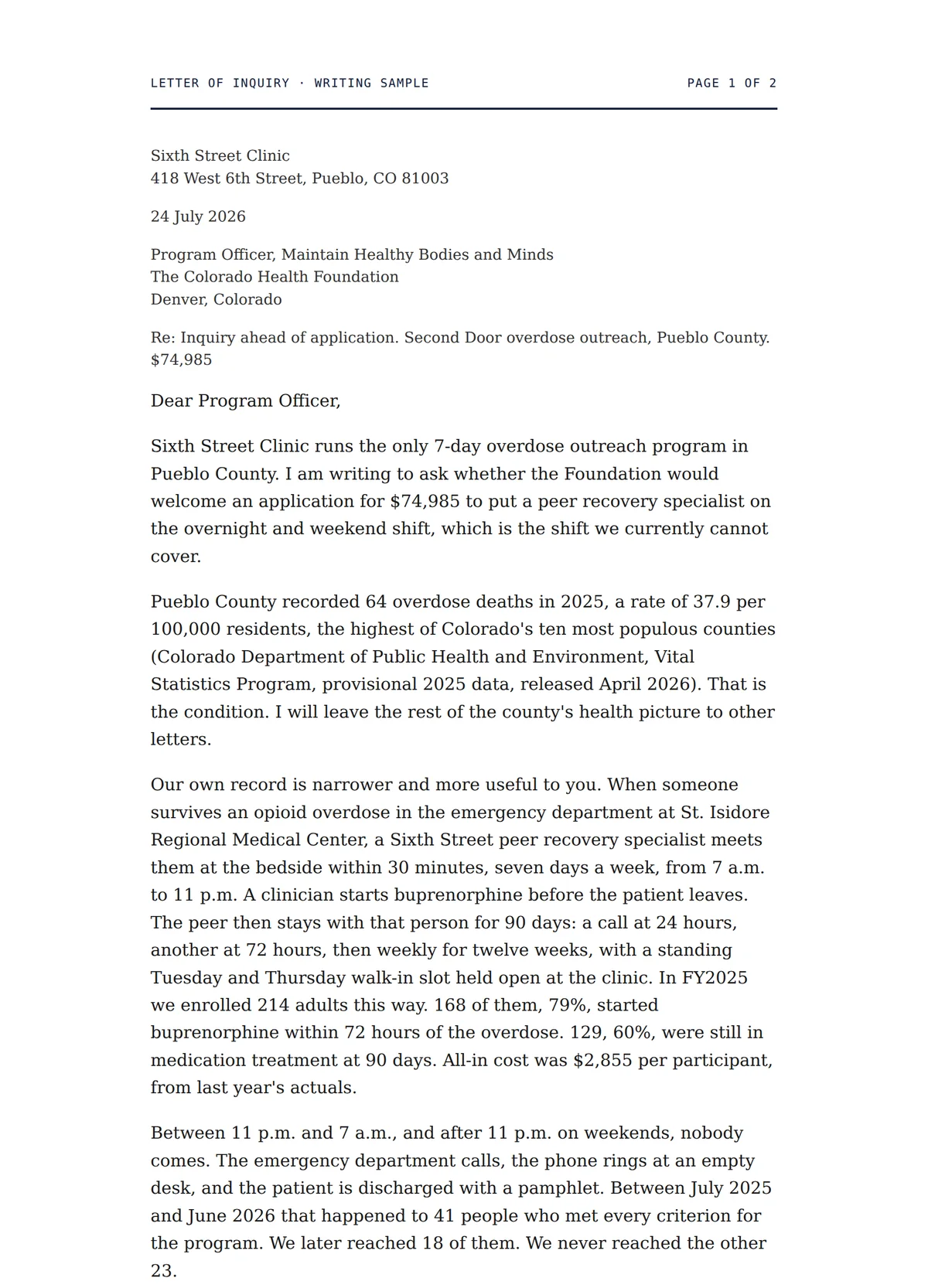
Excerpt · letter of inquiry · $74,985
Between 11 p.m. and 7 a.m., and after 11 p.m. on weekends, nobody comes. The emergency department calls, the phone rings at an empty desk, and the patient is discharged with a pamphlet. Between July 2025 and June 2026 that happened to 41 people who met every criterion for the program. We later reached 18 of them. We never reached the other 23.
Colorado Medicaid reimburses peer support services. Our finance director's estimate is that Medicaid would eventually recover about $24,500 of this position's $55,676 salary and fringe. It would not recover all of it. I am not going to tell you the program becomes self-funding, because it does not.
Where you are
The board has asked for a plan. The plan is more applications than anyone on staff can write.
The replacement for a federal award is foundation and corporate money, which means more applications, to more funders, on more deadlines, each one wanting your outcomes stated differently. The person writing them is you, at night, after the organization has been run. Hiring for it takes three months and near $70,000 a year, and the deadlines do not wait for the search. That gap is the only thing this practice exists to close.
Read from the source
Every proposal opens with the problem. The problem is the cheapest section on the page.
Foundations rarely publish how they score. Federal agencies have to. So 17 real FY2026 notices of funding opportunity, about 158,000 words, were read line by line and every published point weight pulled out. This is what the fourteen scored rubrics pay for.
The corpus
- HRSA ×3
- ACF and ACYF ×4
- SAMHSA
- Department of Labor
- Department of Education ×2
- OVC
- OVW ×2
- AmeriCorps
- USDA Rural Development ×2
Downloaded whole, extracted verbatim. Fourteen publish a numeric rubric.
-
ACFHHS-2026-ACF-ACYF-CA-0037 · Predictive Analytics in Child Welfare0 20.8
-
AmeriCorps94.002 · AmeriCorps Seniors RSVP Competition0 30
-
ACFHHS-2026-ACF-ACYF-CU-0021 · Regional Partnership Grants0 36.4
-
ED84.423A · Supporting Effective Educator Development0 40
-
OVCO-OVC-2026-172620 · Services for Victims of Crime5 35
-
DOLFOA-ETA-26-19 · Pay-for-Performance Incentive Payments8 56
-
HRSAHRSA-26-050 · Rapid Response Rural Data Analysis10 35
-
SAMHSASM-26-019 · Safety Through Recovery and Treatment10 50
-
HRSAHRSA-26-095 · Nursing Workforce Development15 30
-
ACFHHS-2026-ACF-ACYF-CA-0018 · Child Abuse Prevention, Migrant and Tribal18.2 36.4
-
HRSAHRSA-26-046 · Small Health Care Provider Quality Improvement20 25
-
ED84.031A · Strengthening Institutions Program20 30
-
ACFHHS-2026-ACF-ANA-NB-0116 · Native American Language Preservation23.6 45.5
-
OVWO-OVW-2026-172625 · Financial Assistance for Victims Initiative30 35
Every figure is a published weight, normalised to that notice's own total. Criteria were grouped by their printed titles. Notices with no numeric rubric are excluded. The full six-way split is below.
All fourteen rubrics, all six categories
| Notice | Need | Approach | Capacity | Evaluation | Budget | Other |
|---|---|---|---|---|---|---|
| ACF HHS-2026-ACF-ACYF-CA-0018 Child Abuse Prevention, Migrant and Tribal | 18.2 | 36.4 | 18.2 | 13.6 | 4.5 | 9.1 |
| ACF HHS-2026-ACF-ACYF-CA-0037 Predictive Analytics in Child Welfare | 0 | 20.8 | 33.3 | 8.3 | 8.3 | 29.2 |
| ACF HHS-2026-ACF-ACYF-CU-0021 Regional Partnership Grants | 0 | 36.4 | 18.2 | 22.7 | 4.5 | 18.2 |
| ACF HHS-2026-ACF-ANA-NB-0116 Native American Language Preservation | 23.6 | 45.5 | 12.7 | 0 | 9.1 | 9.1 |
| AmeriCorps 94.002 AmeriCorps Seniors RSVP Competition | 0 | 30 | 20 | 0 | 15 | 35 |
| DOL FOA-ETA-26-19 Pay-for-Performance Incentive Payments | 8 | 56 | 18 | 8 | 10 | 0 |
| ED 84.031A Strengthening Institutions Program | 20 | 30 | 18 | 10 | 6 | 16 |
| ED 84.423A Supporting Effective Educator Development | 0 | 40 | 35 | 25 | 0 | 0 |
| HRSA HRSA-26-046 Small Health Care Provider Quality Improvement | 20 | 25 | 20 | 15 | 5 | 15 |
| HRSA HRSA-26-050 Rapid Response Rural Data Analysis | 10 | 35 | 35 | 5 | 5 | 10 |
| HRSA HRSA-26-095 Nursing Workforce Development | 15 | 30 | 15 | 10 | 10 | 20 |
| OVC O-OVC-2026-172620 Services for Victims of Crime | 5 | 35 | 30 | 0 | 15 | 15 |
| OVW O-OVW-2026-172625 Financial Assistance for Victims Initiative | 30 | 35 | 20 | 0 | 15 | 0 |
| SAMHSA SM-26-019 Safety Through Recovery and Treatment | 10 | 50 | 25 | 15 | 0 | 0 |
Restraint is scored, not merely tolerated
One notice awards points for naming no more than three objectives. Another caps evidence citations at two. Writing more is not writing better, and in several competitions it costs points.
Naming your own risks earns points
Eight of the fourteen scored competitions award points for identifying what could go wrong. One prices it as its own criterion worth 5 points.
The writing
The lines add to $74,985, which is why the ask is $74,985 and not $75,000.
From the Sixth Street Clinic letter of inquiry. Both sample documents are published in full, with the budget arithmetic left open so it can be checked.
What arrives
These are the documents, not a description of them
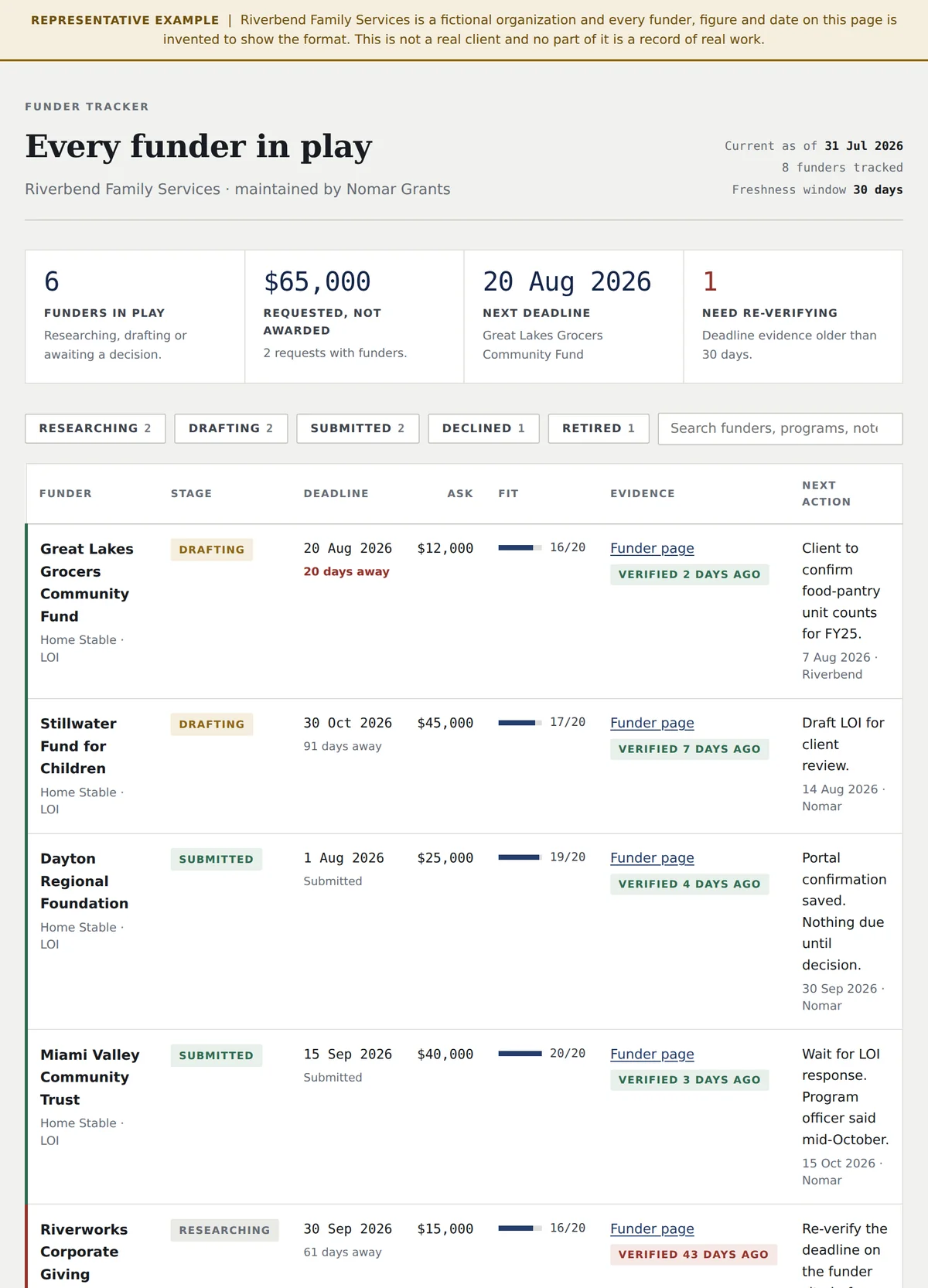
Worked examples generated by the same tooling a client's would be. Open the files and see how a month runs.
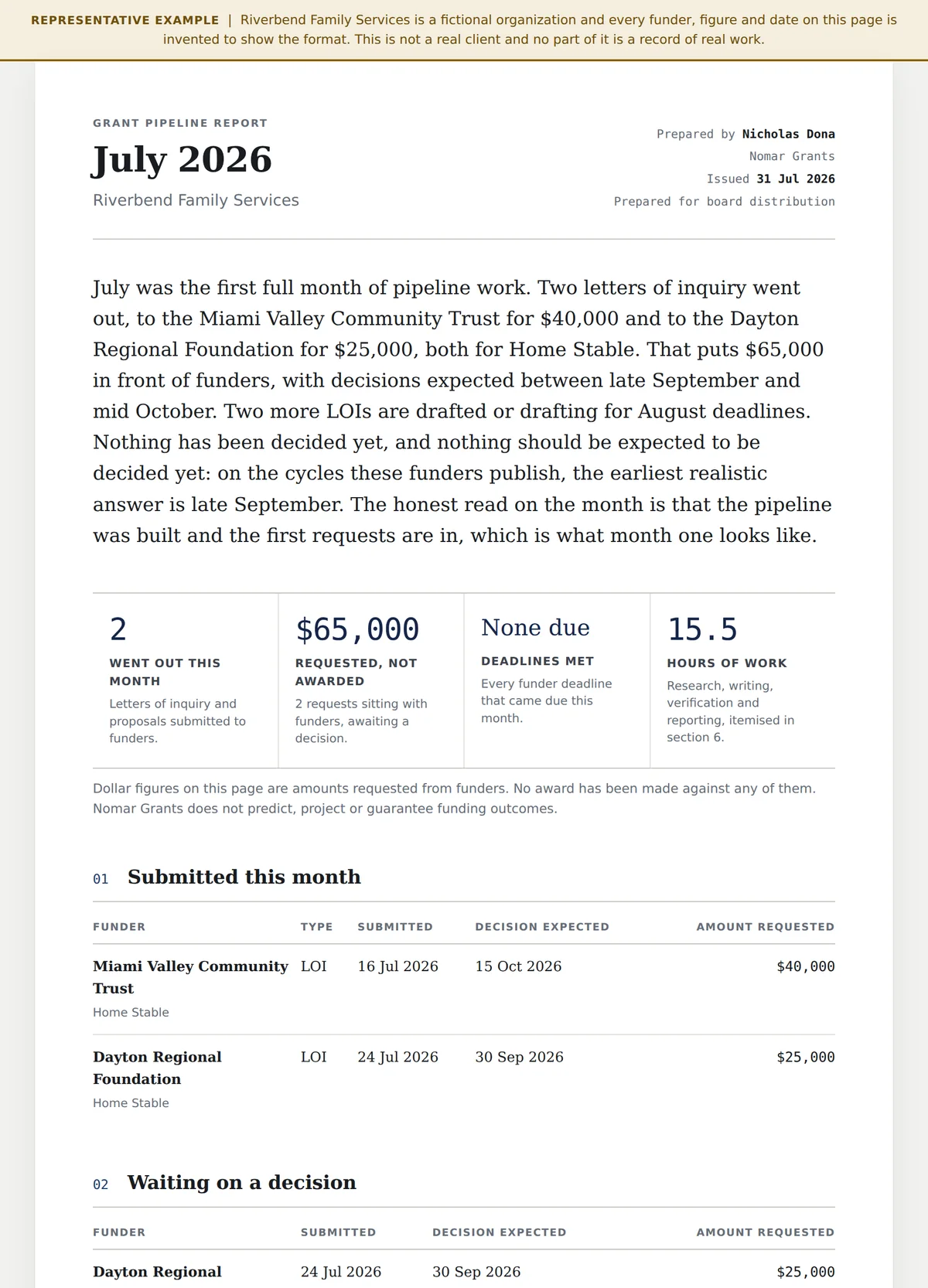
By the 3rd, every month. Written to be read by a board without translation.
Every funder in play, with stage, deadline, ask, fit score and freshness date.
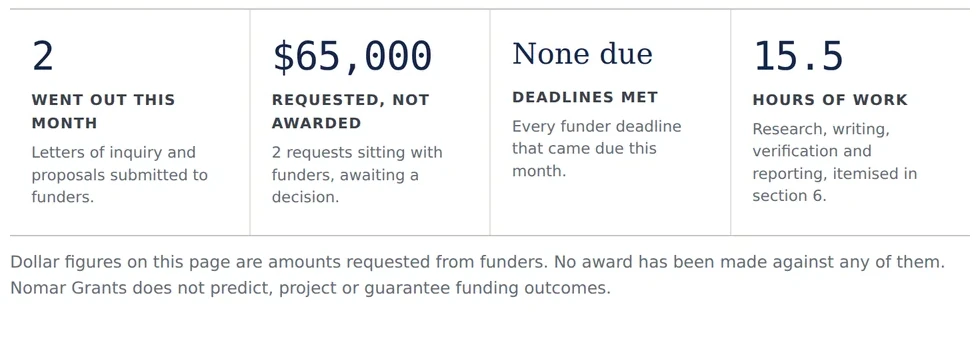
Every dollar figure carries that label wherever it appears. A report that quietly implies wins is the easiest lie in this trade.
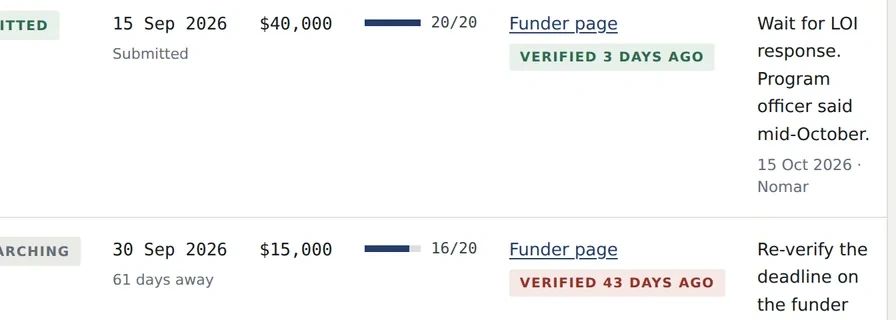
The tracker marks its own stale rows. A deadline nobody has re-read in six weeks turns red instead of sitting there looking current.
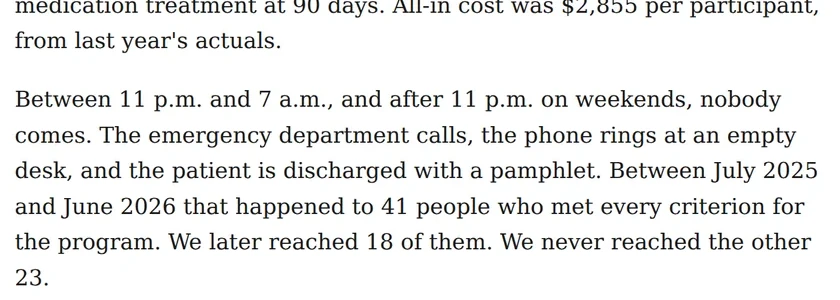
The sentence that makes the case is a count, not an adjective.
What is true today
Nomar Grants is new, so judge it on what you can check
Full samples
You can read the work before you pay for any of it
A two-page letter of inquiry and the eleven-section proposal that follows it, budget arithmetic left open, both carrying a self-grade that includes two 3s out of 5. Read them here.
The size of the risk
The first engagement is one flat-fee project, not a retainer
You should not have to sign an ongoing agreement to find out whether the writing is any good. One funder shortlist, one submission-ready document, two weeks, yours to keep either way.
How AI is used here
The honest version, before anyone has to ask for it
I use AI to draft fast, but I own every word. It is written from your interviews and your own records, and a human fact-check checks every claim before anything reaches a funder. You never get unreviewed machine output.
Nicholas Dona, said on every call, before anyone asks.
What the machine does
- First drafts from the fact file and the interview transcript
- Restructuring one narrative to another funder's section order
- Pulling published scoring weights out of long funding notices
- Tightening prose that is already true
What it is never allowed to do
- Supply a fact. Every figure comes from your records, never from a model
- Decide which funders you go to, or in what order
- Judge whether a claim is defensible
- Reach a funder unread
How you can check it
- Every figure is matched to a line in your fact file before you see the draft
- An unsourceable claim is removed rather than hedged
- Both published samples carry their claims table
Pricing
Three ways to work, all flat fees
Every fee is flat, quoted before anything starts, and does not move with the size of an award.
One-time. No retainer, nothing to cancel.
The full monthly rhythm.
The flex-down floor, without full proposals.
The $750 trial fee is credited against your first month if you move to a retainer within 14 days. There is no discount below these figures. When a budget will not carry the retainer, the scope moves down rather than the price.
Two lines we do not cross
Things a grant writer should not sell you
A percentage of your award
Contingency puts the writer's interests against the application's integrity, and many funders prohibit paying a writer out of awarded funds. Worth asking every grant writer you talk to.
A guarantee of funding
Nobody can promise a funder's decision. What can be controlled is how many good applications reach the right funders on time, and that is what the monthly report is accountable for.
Both follow the Grant Professionals Association Code of Ethics, which prohibits percentage-based compensation and guarantees of outcomes.
Who does the work
Nicholas Dona
One writer, working directly with a small number of organizations. No account manager between you and the person writing, and no junior handoff after the sale.
Before grants, the work was production programs on fixed schedules, where a missed date stops a line and every figure is checked by someone else before it ships. Grant writing is the same discipline pointed at a different deadline: read the funder's own words, write only what the records support, submit on the date.
Foundation and corporate funders only, US 501(c)(3) organizations, flat fees only.
Direct: nicholas@nomargrants.com
Questions
Do you work with organizations like mine?
US 501(c)(3) organizations, roughly $500,000 to $25 million in annual budget, in health, human services, education, legal services, community development and youth work. The common thread is usually federal or state money that is ending. If that is not you, ask anyway and you will get a straight answer about fit rather than a proposal.
Who actually writes it, and how much of it is AI?
Nicholas writes and owns every document that leaves. AI is used for drafting speed, never for facts. Every specific claim is sourced to a line in your fact file and checked before you see the draft. You never receive unreviewed machine output, and the samples are the place to test that claim.
What if we do not get funded?
Grant decisions take three to nine months and nobody can promise one. What is controllable is volume, quality and deadlines, so that is what the monthly report is accountable for. You judge the work every month on that, not on a decision letter that has not arrived yet.
Start
The deadlines pass either way
Send one paragraph about the program that needs funding and get a straight answer about whether this fits, within one business day.
Or book a 20 minute call: calendly.com/nic-j-dona