What you get
What actually arrives, and what it looks like when it does
Three documents rather than a description of a service. Open them, print them, take one into a board meeting.
Read this first
These are representative examples, not client work. Every figure, funder and date in them is invented and the organization named in them does not exist. They show the format and the reporting standard. Each file carries that statement across the top of its own first page, and it stays there in the PDF, so it travels with the document if someone forwards it to you.
The objects
Three documents, generated by the same tooling a client's would be
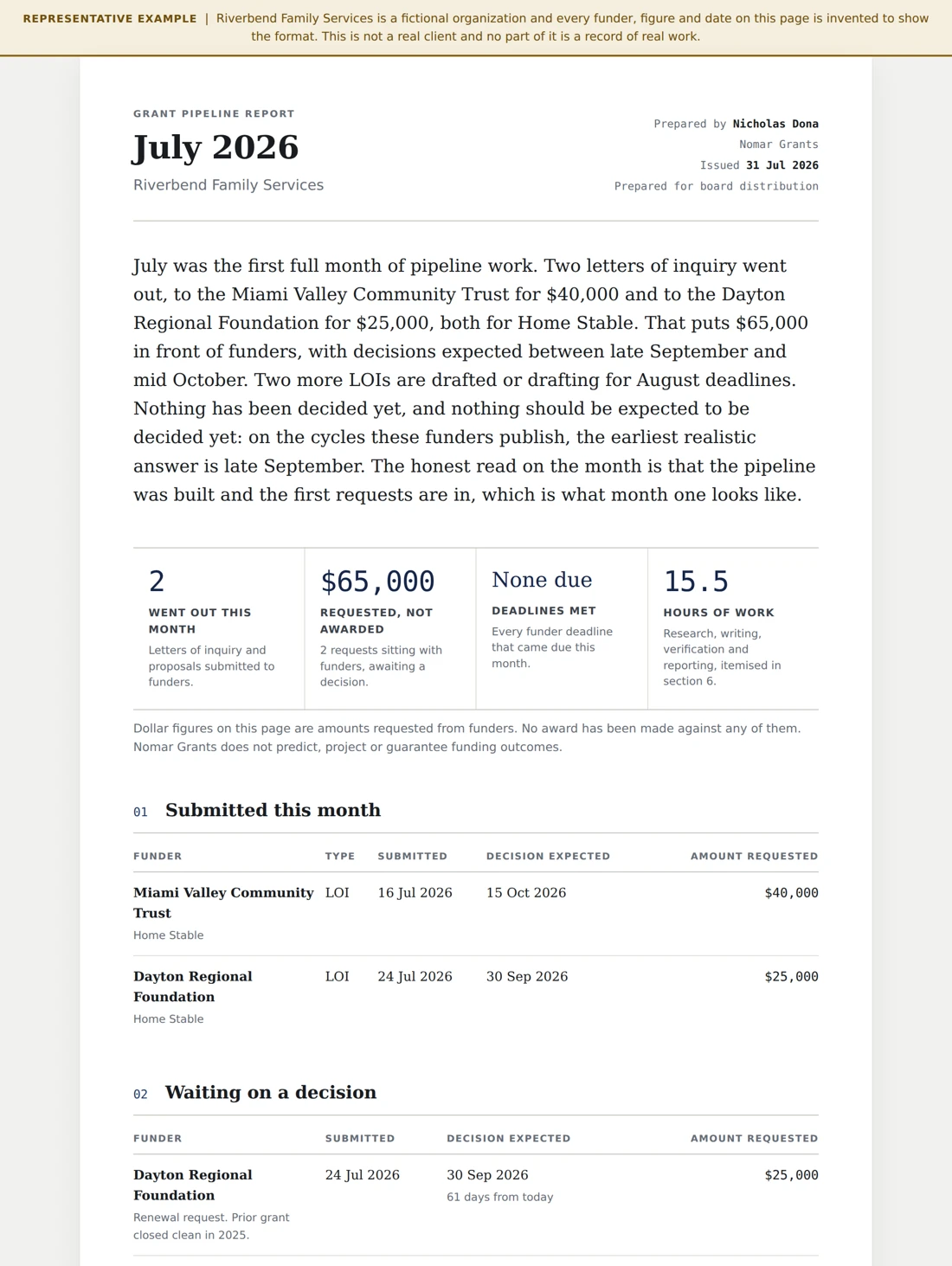
By the 3rd · every month · 3 pages
The grant pipeline report
The document your board reads. A plain paragraph on the month, then four numbers: what went out, what is sitting with funders, deadlines met against deadlines due, and where the hours went. Then the same seven sections, in the same order, every month.
Every dollar figure is labelled requested, not awarded, in the number itself and again underneath. A month with no decisions is reported as a normal month, because it is one.
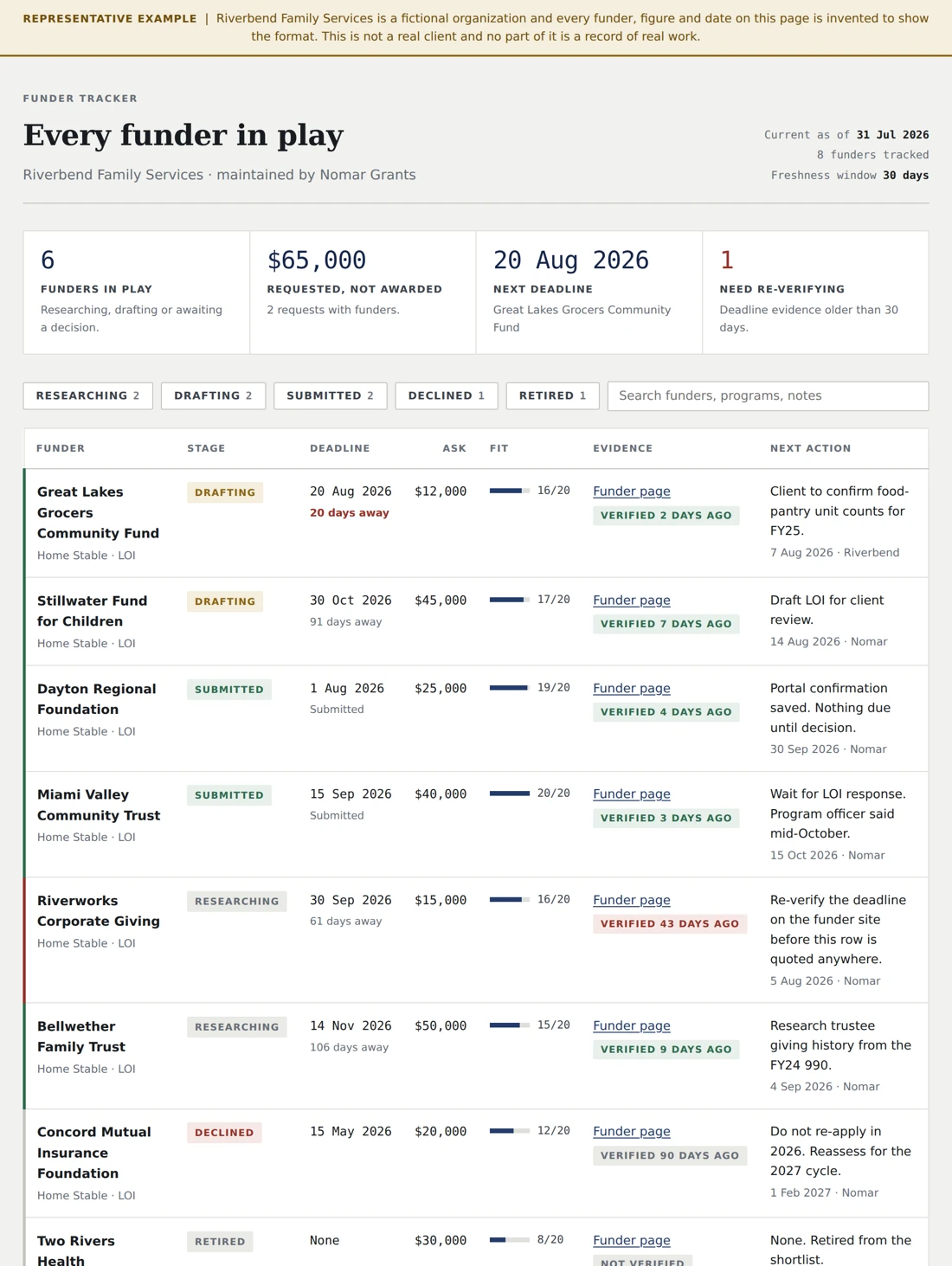
Live · re-checked on a 30 day window
The funder tracker
Every funder in play on one page: stage, fit score with the reason for it, the amount requested, the next deadline, the link to the funder's own guidelines, the next action and who owns it.
Each row carries the date a person last read that funder's own published page. Anything past the 30 day window prints in red, so a stale deadline is visible instead of quietly wrong. This is also the artifact that survives the engagement: if you stop working with Nomar Grants, the tracker and the research behind it stay with you.
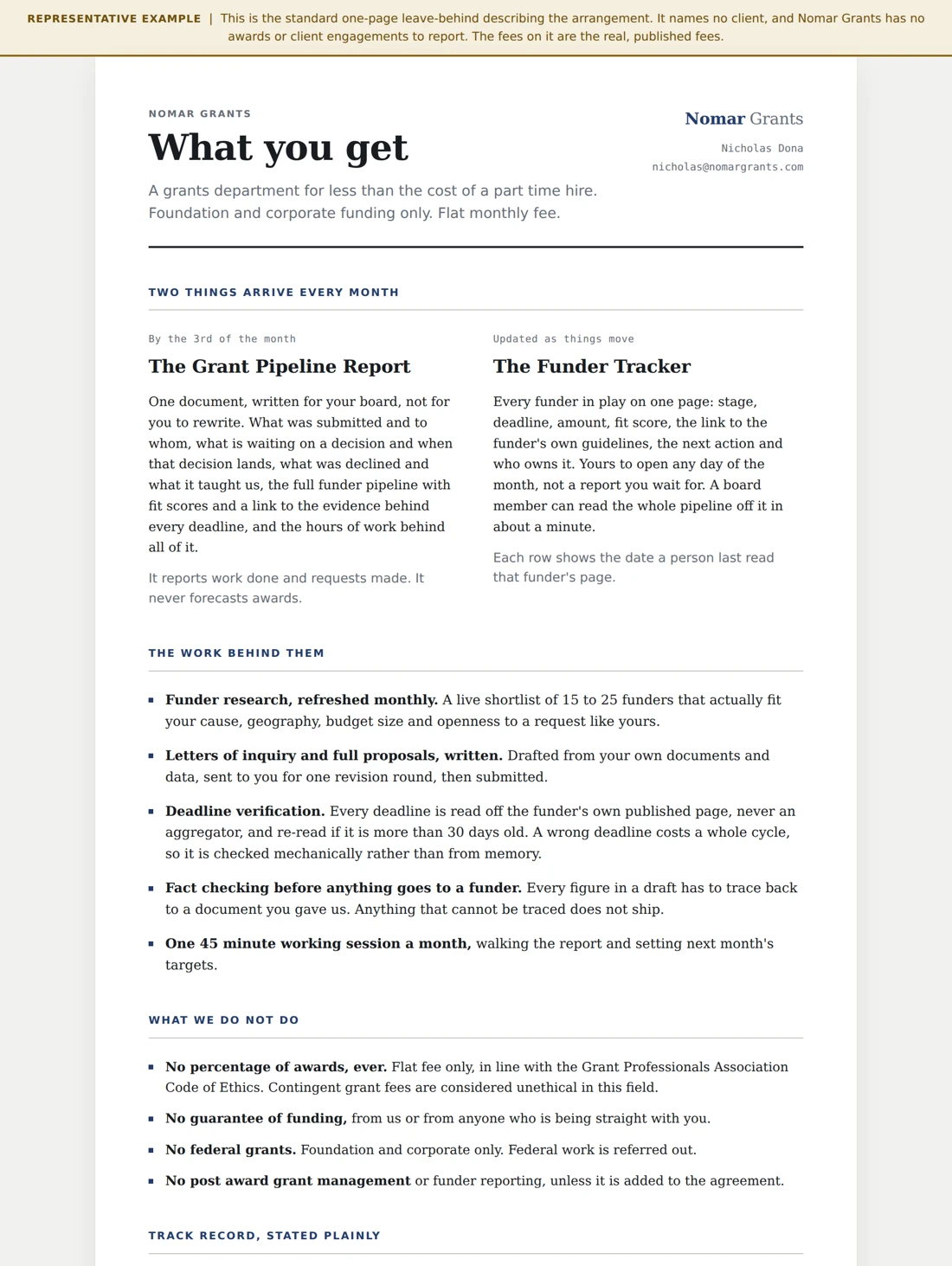
One page · for the board chair who was not on the call
The one-page summary of the arrangement
What arrives, on what date, at what fee, with the two ethical limits printed on it. Written to be forwarded without anyone having to summarise it first. If your board chair reads one page about this practice, it should be this one.
The rhythm
The month has a shape, and the same shape every month
Intake, then a fact file
Interviews with you and your program staff, your 990s, audits, program data and last year's applications, in one source document. Every number that appears in a proposal traces back to a line in it.
The tracker stays current between reports
Funder research is refreshed as the month runs, not assembled the night before the report. You can open the tracker on the 14th and it is true on the 14th.
Letters of inquiry and proposals go out
Two to four letters of inquiry and one to two full proposals at the $2,500 tier, two letters and no full proposals at the $1,500 tier. Written in your organization's voice from the fact file. You approve everything before it leaves.
The report lands, and one working session follows it
The report arrives by the 3rd covering the month just finished. At the $2,500 tier a 45 minute working session walks it and sets next month's targets. Nothing in it is a surprise, because you approved every document in it before it went out.
What is not in it
The things this report will never contain, stated before you buy it
The failure mode of outsourced grant work is a report that gently implies progress that has not happened. So here is what is missing from these pages on purpose.
Predicted awards
No expected award figure, no pipeline value, no weighted total. Until a funder decides, the number is a request.
Win rates or hit rates
A rate built on a handful of decisions is noise dressed as evidence. Decisions are reported one by one, named, with what was learned.
Projections and likelihoods
No forecast, no probability, no strong chance, no looking good. The generator that builds these pages has no field for it, which is a stronger promise than a person telling you they would never say it.
Money implied to be in hand
Every dollar figure carries requested, not awarded, in the number itself and again in the note under it. No total is presented that could be read as revenue.
Federal applications
Foundation and corporate funders only. Federal and grants.gov work is referred out to specialists rather than learned on your budget.
Post-award management
Post-award reporting, events, appeals, major donor work and capital campaigns sit outside the monthly fee. Any of it can be added by written agreement, priced separately.
Fees are flat and never a percentage of an award, and no funding outcome is guaranteed or implied. Both follow the Grant Professionals Association Code of Ethics.
Why it is built this way
The honesty rules are in the code, not in the writer's discipline
These documents are produced by a program, not typed each month, so the constraints are enforced where they cannot be edited away. The requested-not-awarded label is generated onto every figure. The ethics footer is generated onto every page. The freshness date on each funder row is computed from when the source was last read, not typed by the person who would like it to look current.
Which means every claim on this page can be checked against the three files above before you pay anything.
Pricing
What the monthly documents cost, and how to test it for $750 first
One-time, no retainer. A researched funder shortlist, one complete letter of inquiry or full proposal ready to submit, and the working file of research, boilerplate and budget language. Two weeks. Yours to keep either way.
Everything on this page: maintained tracker, two to four letters of inquiry and one to two full proposals written and submitted, the board report by the 3rd, one 45 minute working session. Three month initial term, then month to month.
Funder research, the maintained tracker and the monthly report, plus two letters of inquiry a month, without full proposals. For organizations that write their own proposals but cannot find and qualify funders.
The $750 trial fee is credited against your first month if you move to a retainer within 14 days. Fees do not move with the size of an award. Full detail on the terms page.
Start
You have now seen the deliverable before paying for it
That is the point of this page. Send one paragraph about the program that needs funding and you will get a straight answer about whether this fits, within one business day.
Or book a 20 minute call: calendly.com/nic-j-dona